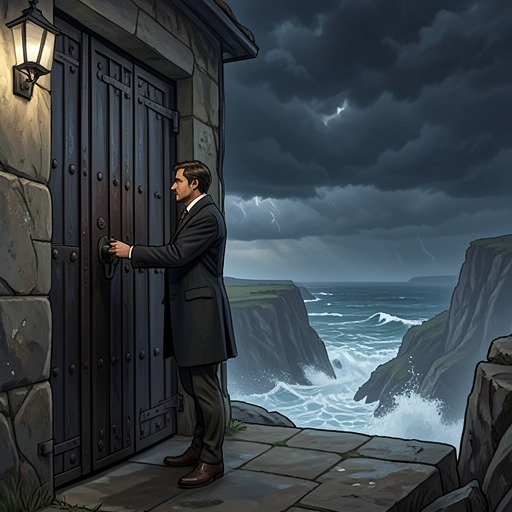
Campbell
The North WaterCampbell is the captain of the Hastings and a quiet but consequential partner in the plot surrounding the Volunteer. He joins Brownlee and Baxter in a plan to turn the ship’s loss into a financial transaction, helping determine when and where it should happen and how its appearance might withstand scrutiny. His role is marked less by dramatic action than by strategic timing: he waits apart from the Volunteer, urges Brownlee not to delay, and treats the presentation of the wreck as essential to its success.
Identity and Position
Campbell is associated with the Hastings, which is to cooperate with the Volunteer while the two vessels keep their connection concealed. Before the ships meet in the northern waters, Brownlee insists that Campbell must be present when needed; otherwise, he warns Baxter, he will turn the Volunteer around and sail home. Baxter assures him that Campbell will appear, adding that a successful operation would put Campbell next in line. The exchange establishes Campbell not as a passing contact but as someone whose participation is necessary to the arrangement and whose prospective benefit depends on its outcome.
The narrative offers only a limited portrait of Campbell away from the conspiracy. When the captains gather during the delay near Pond’s Bay, he is described as shrewd, friendly to a degree, but also secretive and sometimes superior. His upturned nose, broad cheeks, long side-whiskers, and narrow lips are observed by Brownlee, who finds his expression difficult to read. That guarded manner fits the practical reserve with which Campbell discusses the plan: he can speak as a colleague, yet his questions and instructions keep the intended business in view.
The Concealed Arrangement
The scheme takes shape against the commercial pressures Baxter has already emphasized. He presents papers to Brownlee and stresses the large sum to be divided among three people, comparing it with what Brownlee could hope to earn from whaling. Baxter also describes money as a force that finds its own route, whether or not the people involved prefer it. Campbell’s role belongs to that same conversion of a working voyage into a financial operation: the Volunteer must appear to suffer a plausible maritime loss, while the participants position themselves to benefit from the insurance arrangement.
The two ships’ movements are kept deliberately separate. As the Volunteer sails north, Campbell is waiting ahead in the Hastings, somewhere beyond Disko Island. The ships are not to meet or communicate until the moment is judged right. The precaution is tied to the Volunteer’s unusually large insurance: underwriters, alert to signs of conspiracy, might regard the vessel’s coverage as suspicious even before any loss occurred. Campbell’s absence from the Volunteer is therefore part of the plan’s concealment, not evidence that he has no role in it.
When Campbell and Brownlee speak alone in Brownlee’s cabin, Campbell tests whether Brownlee is ready to proceed. Brownlee’s answer is that there is time to kill more whales before moving on. Campbell rejects that priority: the catch is incidental to the larger operation, and there may not be many opportunities to sink the ship in a way that looks convincing. He warns that the outward appearance matters and that an obvious arrangement could prompt questions from the underwriters. The conversation shows Campbell thinking in terms of the story an accident must tell, not simply the physical destruction of a vessel.
Timing, Route, and the Whaling Season
Campbell’s proposed timing is shaped by danger as well as concealment. He wants to move sooner rather than later because remaining in the region risks leaving him trapped by the ice. Brownlee asks for one more week in Pond’s Bay, hoping to take advantage of any remaining whaling opportunity; Campbell accepts the delay but sets a limit, after which he wants them heading north again. Their agreement makes the operation dependent on both men’s circumstances: Brownlee still wants to act as a whaling captain, while Campbell is concerned that the conditions could close off his escape or access.
Campbell specifies Lancaster Sound or its vicinity as the next destination. There, he reasons, other ships are unlikely to follow. His proposed method is to find a sheltered lead near substantial land ice and wait for the wind to drive the floes back against the vessel. He also doubts that Brownlee’s crew will offer much help. These instructions connect the geography of the voyage to the intended appearance of the loss: remoteness limits witnesses, while moving ice supplies a plausible mechanism for damage. Campbell is not merely urging a general risk; he offers a location and a sequence of conditions meant to make the destruction seem credible.
The plan unfolds amid the ordinary business and uncertainty of the expedition. After the sealing hunt, Brownlee detects optimism among the men, and the crew prepares for whaling as the Volunteer travels north. Campbell remains aboard the Hastings, out of immediate contact until the agreed moment. Later, ice and poor weather constrain the ships. The Hastings moors alongside the Volunteer and other whalers while dense seasonal ice delays their progress. In that interval, the captains dine and talk, giving Campbell and Brownlee an opportunity to discuss their arrangement without the whole crew present.
Failure of the Catch and Campbell’s Narrative Role
The commercial voyage does not supply the easy cover of a productive season. Once the ice opens and the ships enter Pond’s Bay, sightings are scarce; whales disappear below the ice, and the boats return without strikes. Brownlee begins to consider whether Baxter was right that the trade is failing, though he finds it difficult to accept that the oceans could have been emptied so quickly. After a week of unsuccessful hunting, he accepts the situation, signals Campbell as agreed, and tells the crew that the Volunteer is leaving the bay to seek better luck farther north. Campbell’s plan advances not because whaling succeeds, but because its disappointing results help force a decision about the voyage’s next stage.
Campbell’s part is therefore defined by coordination, concealment, and pressure on timing. He is presented as a practical conspirator who understands that an insurance loss must be arranged and must also look accidental. The later account of the plot confirms that Brownlee’s suspicions concerned the deliberate sinking of the Volunteer: in a subsequent confrontation, Sumner identifies Baxter as the person who had Campbell sink the ship. That retrospective disclosure fixes Campbell’s place in the conspiracy, although the evidence here does not establish his ultimate fate or describe his actions after the plan’s exposure. His narrative significance lies in making the ship’s passage through remote, ice-bound waters serve two purposes at once: a whaling voyage on its surface, and a carefully staged financial loss beneath it.